Agentic trading · 2026 guide
What is agentic trading?
AI is moving from answering trading questions to doing trading work: finding setups, writing plans and watching them for you. Here’s what an AI trading agent actually does, how it differs from bots and chatbots, and what to check before you trust one.
Three levels of autonomy
Not every agent trades for you.
“Agentic” describes how the software works, not how much control it takes. Most tools today sit at the first two levels.
- Level 1
Research agent
Pulls quotes, candles, calendars and news through tools, then explains what it finds. It answers questions; it doesn’t track anything after the conversation.
You decide, enter and manage everything.
- Level 2
Trade companion
Finds setups, writes a conditional plan with entry, stop and targets, then watches that plan live and tells you when something on it changes.
You still confirm every entry and exit.
- Level 3
Autonomous agent
Connects to a brokerage account and places, adjusts and closes orders itself, inside limits you set.
You set the rules and the risk limits; the agent acts.
How an AI trading agent works
Observe, reason, plan, act, check.
The difference from a chatbot is the loop: the agent keeps gathering evidence and comparing it with the plan.
01Observe
Calls tools for live quotes, closed candles, economic and earnings calendars, news and sector performance, instead of answering from memory.
02Reason
Reads market structure, support and resistance, momentum and upcoming events, then decides whether there is a trade at all.
03Plan
Writes conditional scenarios: what has to happen first, where the idea is wrong, and what the targets are.
04Act
Saves the plan, watches price, raises alerts, or in a fully autonomous system, sends orders.
05Check
Compares new evidence with the plan and says when a setup is ready, invalidated or no longer worth watching.
Bots vs chatbots vs agents
Same AI buzzword, very different tools.
Rule-based bot
What decidesFixed if-then rules you wrote
AdaptsNo
What it doesPlaces orders automatically
AI chatbot
What decidesA language model, often without live data
AdaptsWithin one conversation
What it doesNothing; it only answers
AI trading agent
What decidesA model that calls market-data tools and follows a plan
AdaptsYes, as new data arrives
What it doesScans, plans, monitors and alerts
Autonomous agent
What decidesA model with tools and broker access
AdaptsYes
What it doesAlso places and manages orders
Before you trust one
What a good agent actually does.
Grounded in real market data
Every price, level and event should come from a data tool, not the model’s memory. Ask where a number came from.
Conditional plans, not predictions
A good agent says “if this happens, then…” and names the invalidation. Certainty is a red flag.
Willing to say “no trade”
Mixed structure or missing data should produce “no clean setup”, not a forced idea.
Clear about what it did
It should never claim an order was filled or a stop moved unless that actually happened.
Separates observation from cause
A move near an earnings date isn’t proof the earnings caused it. Good agents only attribute causes they can evidence.
Keeps you in control of risk
It should push back when you want to widen a stop to avoid a loss, not help you rationalize it.
Honest about coverage
Which markets, sessions and instruments it supports, and what happens when data is stale.
In practice
What that looks like.
A real analysis from Sena, Senntric’s AI trading agent, on an NVDA setup.
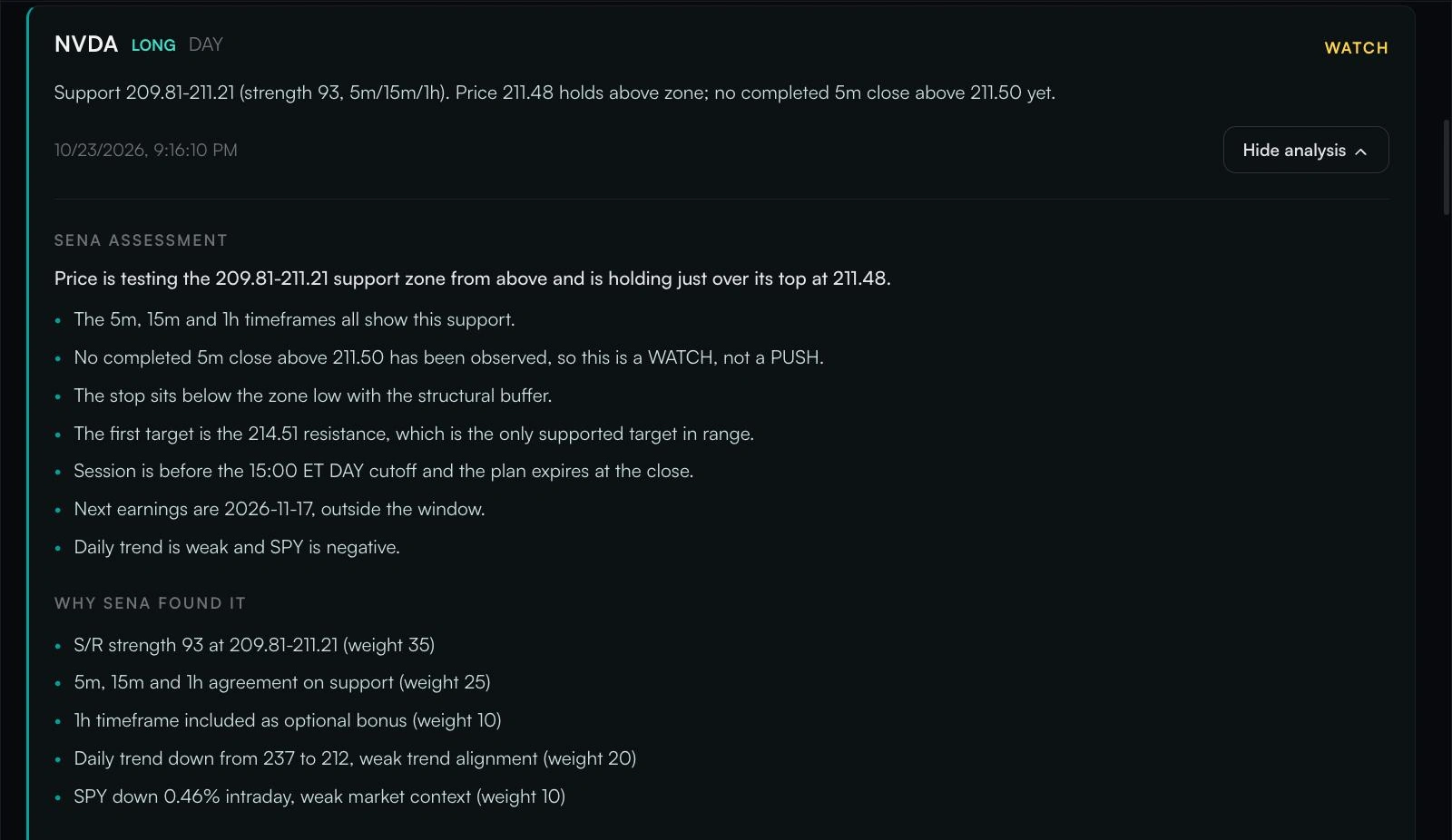
- 1Grounded in real data The support zone, its strength and the timeframes that agree all come from live market data.
- 2Willing to wait No completed 5m close above the trigger yet, so Sena calls it a watch, not a push.
- 3Shows its reasoning Every factor behind the setup is listed with its weight, including the ones against it.
Honest risks
Agents don’t remove trading risk.
They change which mistakes you can make.
Confident mistakes
Language models can state wrong numbers fluently. Agents that don’t ground every figure in data will eventually invent one.
Automation bias
It is easy to trust a polished explanation over your own read of the chart. The plan is only as good as its evidence.
Execution risk
Autonomous agents add order-routing, slippage and connectivity failures to the usual market risk.
Regulation
An agent that manages money or places trades for others can fall under investment-adviser or broker rules, depending on where you are.
Overfitting to recent markets
Setups that worked last month can stop working. No agent removes regime change.

Where Senntric fits
Sena is a level 2 agent, by design.
Senntric’s AI trading companion finds setups, writes conditional plans and stays with you through the trade, using Senntric’s live market data. You make every entry and exit. Autonomous execution is on our roadmap.
Meet SenaQuestions traders ask
Agentic trading FAQ
What is agentic trading?
Agentic trading is trading supported by AI agents: software that can pursue a goal over several steps, using tools such as live market data, scanners, charts and alerts, instead of just answering one question. Agents range from research assistants to trade companions that monitor your plan, up to fully autonomous systems that place orders.
What is an AI trading agent?
An AI trading agent is a language model connected to market-data tools. It observes the market, reasons about structure and events, writes conditional trade plans, and keeps checking new data against them. Depending on the product, it either alerts you or acts on a brokerage account itself.
Is agentic trading the same as algorithmic trading?
No. Algorithmic trading runs fixed rules that a person wrote. An AI agent reasons over new information and can explain its decisions in plain language. Many agentic tools also stop short of execution, while algorithmic systems exist to execute.
Can an AI agent trade for me?
Some can, through a brokerage connection and limits you set. Many current AI trading agents, including Sena by Senntric today, research, plan and monitor trades but leave every entry and exit to you. Meet Sena.
Is agentic trading safe?
It carries the normal risks of trading plus new ones: confident mistakes, over-reliance on the agent, and execution failures in autonomous systems. Use agents that ground every number in real data, explain their invalidation levels and keep you in control of risk.
How is an AI trading agent different from ChatGPT?
A general chatbot answers from its training data and often has no live market feed. A trading agent calls market-data tools for current quotes, candles and calendars, follows trading-specific rules, and can keep watching a saved plan after the conversation ends.
Will AI agents replace traders?
Not soon for discretionary traders. Agents are good at gathering evidence, staying consistent and watching many things at once. Judgement about risk, context and when to sit out still sits with the trader.