Strategy testing
Forward testing vs backtesting.
A backtest shows how rules would have traded. A forward test shows whether they still work on days nobody has seen.
Backtest
Past data, seconds to run
Forward test
Live, simulated money
Side by side
What each one proves.
Past data
Backtesting
- Speed
- Years of trades in seconds
- Proves
- The rules would have worked
- Risk
- Fitted to the past
Live from today
Forward testing
- Speed
- As fast as the market trades
- Proves
- The rules still work on new days
- Risk
- Too few trades, too soon
The catch
Why backtests look too good.
Overfitting
Rules tuned until they match the past.
Too many tries
Test enough versions and one wins by luck.
Look-ahead
Using data you couldn’t have had yet.
Kind fills
Filling at the level, not the next price.
No costs
Small per trade, large over hundreds.
Small samples
Twenty good trades can be luck.
A real example
One filter, two results.
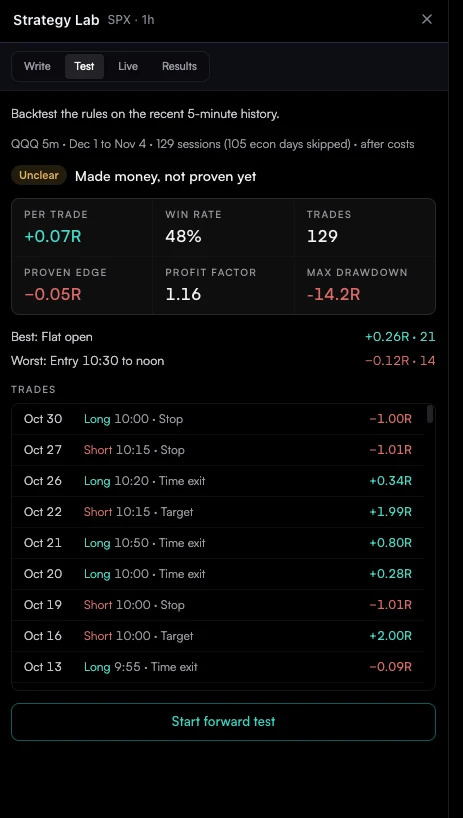
The 15-minute opening range breakout on QQQ, 12 months, after costs. Skipping economic release days made it profitable, but we chose that filter after seeing the results, so Proven Edge stays below zero. That is what a forward test is for.
No edgeEvery day
- Per trade
- −0.05R
- Win rate
- 44%
- Trades
- 234
- Proven Edge
- −0.13R
- Profit factor
- 0.90
- Max drawdown
- −26.9R
UnclearRelease days skipped
- Per trade
- +0.07R
- Win rate
- 48%
- Trades
- 129
- Proven Edge
- −0.05R
- Profit factor
- 1.16
- Max drawdown
- −14.2R
All four runs: opening range breakout backtest.
Reading the result
Judge it against the backtest.
Not against zero. Strategy Lab tracks each forward test against what its backtest expects: on track above the line, watch below it, off track below the 90% band.
From idea to live
Five steps, in order.
- 01
Write rules
Before any results
- 02
Backtest
Hundreds of trades
- 03
Note changes
Filters added after
- 04
Forward test
Same rules, live
- 05
Go live small
Keep measuring
Strategy Lab
Backtest and forward test the same rules.
Describe a strategy in plain English, backtest it after costs, then press Forward test. Trades show on your chart. No real orders.
Questions traders ask
Forward testing FAQ
What is the difference between backtesting and forward testing?
Backtesting runs a strategy’s rules on historical data. Forward testing runs the same rules on live data from now on, usually with simulated money, so the result cannot have been fitted to the past.
Is forward testing better than backtesting?
Neither replaces the other. Use the backtest to decide whether an idea is worth testing live, and the forward test to decide whether it is worth real money.
Is forward testing the same as paper trading?
They overlap. Paper trading usually means placing simulated trades by hand, which also tests your execution. A rule-based forward test applies fixed rules automatically. Neither uses real money.
How long should you forward test a strategy?
Until you have enough trades to compare with the backtest, not a fixed number of weeks. A strategy that trades once a day needs a month or more for 20 to 30 trades.
How many trades do you need to trust a backtest?
There is no magic number, but small samples are easy to get lucky with. Senntric’s Strategy Lab does not show its Proven Edge estimate until a test has at least 30 trades.
Can I backtest and forward test in Senntric?
Yes. In Strategy Lab you describe a strategy in plain English, backtest it after costs, and forward test the same rules on the live market with simulated money. See how Strategy Lab works.