Backtest · QQQ · 12 months
Opening range breakout backtest: 12 months of QQQ, after costs.
We tested the classic opening range breakout on QQQ with 5, 15 and 30-minute ranges, over 234 sessions of 5-minute data, in Senntric’s Strategy Lab. Here are the exact rules, every result, and what happened when we filtered out economic release days.
Education, not investment advice. Past backtest results do not predict future results.
The rules
What exactly did we test?
The textbook version, with no filters. History ran from December 1, 2025 to November 4, 2026. Only the range length and, in one run, the econ-day setting changed.
- Symbol and candles
- QQQ, 5-minute candles, regular session
- Direction
- Long or short
- Level
- The opening range (the high and low of the first 5, 15 or 30 minutes)
- Entry
- A 5-minute candle closes beyond the range; the trade fills at the next candle’s open
- Stop
- The other side of the range, no buffer
- Target
- 2R (twice the distance to the stop)
- Trades a day
- One, entered no later than 2:00 pm ET
- Exit
- Target, stop, or flat at 3:55 pm ET
- Costs
- $0.02 a share round trip, taken off every trade
The results
Four runs, no proven edge.
All results are after costs and measured in R, a trade’s result divided by its risk to the stop. The 30-minute range has fewer trades because some days never broke out before 2:00 pm.
| Run | Per trade | Win rate | Trades | Profit factor | Max drawdown | Proven Edge | Verdict |
|---|---|---|---|---|---|---|---|
| 5-minute rangeRange 9:30–9:35 · econ days traded | Per trade−0.07R | Win rate38% | Trades234 | Profit factor0.88 | Max drawdown−26.6R | Proven Edge−0.17R | No edge |
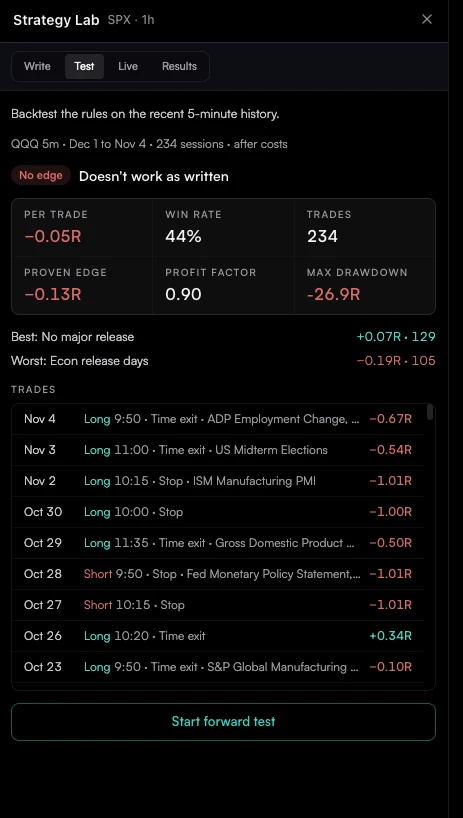
| 15-minute rangeRange 9:30–9:45 · econ days traded | Per trade−0.05R | Win rate44% | Trades234 | Profit factor0.90 | Max drawdown−26.9R | Proven Edge−0.13R | No edge |
| 30-minute rangeRange 9:30–10:00 · econ days traded | Per trade−0.02R | Win rate47% | Trades224 | Profit factor0.94 | Max drawdown−15.7R | Proven Edge−0.09R | No edge |
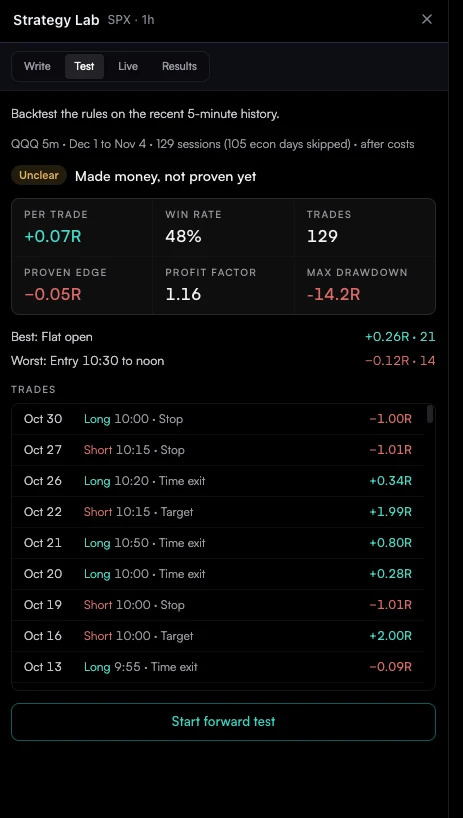
| 15-minute range, econ days skippedRange 9:30–9:45 · econ days skipped (105 days) | Per trade+0.07R | Win rate48% | Trades129 | Profit factor1.16 | Max drawdown−14.2R | Proven Edge−0.05R | Unclear: made money, not proven yet |
What the numbers say
Four things the backtest showed.
01Longer ranges lost less
Per-trade results improved from the 5-minute range (−0.07R) to the 15-minute (−0.05R) and the 30-minute (−0.02R), and the 30-minute drawdown was much smaller (−15.7R). None of them made money as written.
02Release days did the damage
In all three ranges, days with a high-impact US economic release were the worst group, between −0.17R and −0.19R a trade over about 100 trades each.
03A filter chosen after the fact proves little
Skipping release days turned the 15-minute version positive (+0.07R, profit factor 1.16). We picked that filter because the breakdown pointed to it, so it fits this sample by design. Proven Edge stayed below zero (−0.05R).
04Win rate is not the point
The 30-minute range won 47% of trades and still lost overall. With a 2R target, what matters is how big the wins are against the losses, which is why results are in R.
What would change the read: the econ-day filter holding up in a forward test, on days it has not seen yet. Until then it is a hypothesis. See forward testing vs backtesting.
Other research
Why do other ORB backtests look better?
Some do. In a 2023 working paper, Zarattini and Aziz studied an ORB strategy on QQQ from 2016 to 2023 and reported large returns over buy and hold, net of commissions, using leverage. Earlier, Holmberg, Lönnbark and Lundström (Finance Research Letters, 2013) assessed the profitability of ORB strategies in an academic setting.
Different results are not a contradiction. Those studies use different rules, periods, position sizing and costs from the test here, and a working paper is not peer reviewed. Our test covers one recent year of one ETF with a fixed 2R target.
The bigger risk is the number of variations people try. Harvey and Liu (Journal of Portfolio Management, 2015) show why results should be discounted when many versions of a strategy were tested before the best one was reported. That applies to our econ-day filter too.
Test your own version
What can you change in an ORB?
Every one of these is a setting in Strategy Lab. We have not published results for them; test the version you actually trade, then forward test it.
Range length
5, 15 or 30 minutes. Longer ranges give fewer, later signals with wider stops.
Entry trigger
A close beyond the range (break), or a retest: touch, bounce or reclaim of the range edge.
Candle confirmation
Require an engulfing, hammer or inside-bar signal candle.
Trend and gap filters
Only take longs in a daily uptrend, or only trade after a gap up or down.
Volume and volatility
Require relative volume above normal, or higher or lower volatility than usual.
Stops and targets
A buffer beyond the range, an ATR stop, the next level as the target, a trailing stop, or half off at 1R.
Calendar
Skip high-impact US release days or the stock’s earnings days.
Run it yourself
Backtest your ORB in one sentence.
Describe your opening range breakout in Strategy Lab, check the rules Sena builds, and see every trade after costs. Then forward test it on the live market with simulated money before risking your own.
Questions traders ask
Opening range breakout FAQ
What is an opening range breakout (ORB)?
An opening range breakout trades a move out of the high-low range set in the first minutes of the regular session, commonly the first 5, 15 or 30 minutes after the 9:30 am ET open. A long triggers above the range high and a short below the range low, with the stop usually on the other side of the range.
Does the opening range breakout work?
In our test on QQQ from December 1, 2025 to November 4, 2026, the plain 5, 15 and 30-minute versions all lost a little per trade after costs, and none showed a proven edge. Other studies with different rules, markets and periods have reported profits. Results depend heavily on the rules, the market and the period, so test the exact version you plan to trade.
What is the 15-minute opening range breakout success rate?
In this test, the 15-minute ORB on QQQ won 44% of 234 trades, with a 2R target and a stop on the other side of the range. It still lost −0.05R a trade on average after costs, so the win rate alone does not tell you whether it is profitable.
Which opening range is best: 5, 15 or 30 minutes?
In this sample, the 30-minute range lost the least (−0.02R a trade) and had the smallest drawdown, and the 5-minute range lost the most (−0.07R). That is one year of one ETF, not a general rule.
Should I avoid trading the opening range on CPI or jobs days?
In this test, high-impact US economic release days were the worst group for every range length. That is a pattern in one sample, and we found it by looking at the results, so treat it as something to forward test rather than a rule.
What does Proven Edge mean?
Proven Edge is Strategy Lab’s conservative estimate of the average result per trade: the lower end of a one-sided 90% confidence range, shown once a test has at least 30 trades. Above zero suggests the profit is unlikely to be luck alone. All four runs here were below zero.
How can I backtest my own opening range breakout?
In Senntric’s Strategy Lab, describe the version you trade in plain English, check the rules Sena builds, and run it on 3, 6, 12 or 24 months of 5-minute data. You can change the range, trigger, filters, stop and target with dropdowns. See how AI backtesting works.
Sources
- Backtests: Senntric Strategy Lab, QQQ 5-minute regular-session data, December 1, 2025 to November 4, 2026, run November 5, 2026.
- Zarattini, C. and Aziz, A. (2023). Can Day Trading Really Be Profitable? SSRN working paper.
- Holmberg, U., Lönnbark, C. and Lundström, C. (2013). Assessing the profitability of intraday opening range breakout strategies. Finance Research Letters 10(1).
- Harvey, C. R. and Liu, Y. (2015). Backtesting. The Journal of Portfolio Management 42(1).