AI trading · Tested
Do AI trading bots work? We tested one on a year of data.
An AI trading platform that trades for you sounds like the dream. So we took one of the classic rules day-trading bots automate, ran it on 234 sessions of QQQ after costs, and checked what the ads leave out.
Education, not investment advice. Past results do not predict future results.
What you are buying
Four kinds of bot that trade for you.
Rule bots
Buy or sell when a fixed condition hits, such as a breakout, a moving-average cross or an RSI level.
RiskOnly as good as the rule. Most rules have no edge after costs.
Grid and DCA bots
Buy and sell on a ladder of prices, common on crypto exchanges.
RiskEarn in a sideways market, then pile into losses when price trends.
Copy and signal bots
Copy another trader’s orders or act on a paid signal channel.
RiskYou inherit results you cannot verify, plus the signal seller’s fees.
“AI” bots
Usually one of the above with an AI label. True machine-learning models are rare and need constant retraining.
RiskA promise of intelligence you cannot test, which is what fraud relies on.
Our test
A popular bot rule, a year of QQQ.
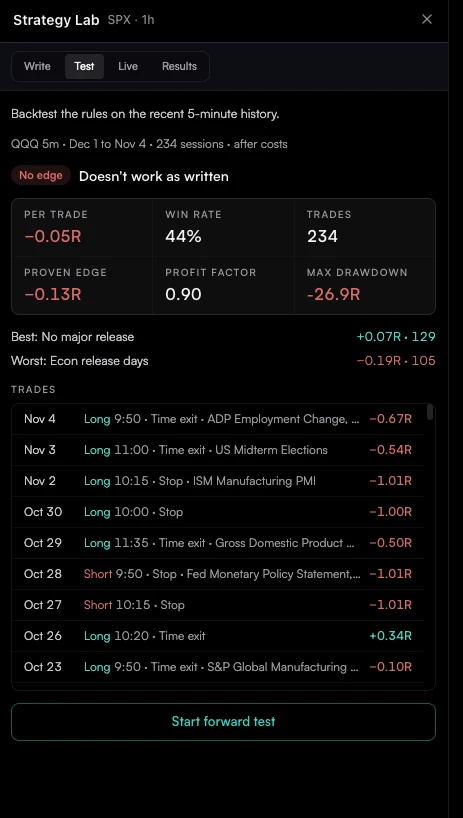
The opening range breakout is one of the oldest rules traders automate: buy a break above the first minutes’ high, short a break below the low, stop on the other side, target twice the risk. We ran it in Senntric’s Strategy Lab on 5-minute QQQ data from December 1, 2025 to November 4, 2026, with costs taken off every trade.
The 15-minute version, after costs
- Per trade
- −0.05R
- Win rate
- 44%
- Trades
- 234
- Proven Edge
- −0.13R
- Profit factor
- 0.90
- Max drawdown
- −26.9R
| Run | Per trade | Win rate | Trades | Profit factor | Max drawdown | Proven Edge | Verdict |
|---|---|---|---|---|---|---|---|
| 5-minute rangeRange 9:30–9:35 · econ days traded | Per trade−0.07R | Win rate38% | Trades234 | Profit factor0.88 | Max drawdown−26.6R | Proven Edge−0.17R | No edge |
| 15-minute rangeRange 9:30–9:45 · econ days traded | Per trade−0.05R | Win rate44% | Trades234 | Profit factor0.90 | Max drawdown−26.9R | Proven Edge−0.13R | No edge |
| 30-minute rangeRange 9:30–10:00 · econ days traded | Per trade−0.02R | Win rate47% | Trades224 | Profit factor0.94 | Max drawdown−15.7R | Proven Edge−0.09R | No edge |
| 15-minute range, econ days skippedRange 9:30–9:45 · econ days skipped (105 days) | Per trade+0.07R | Win rate48% | Trades129 | Profit factor1.16 | Max drawdown−14.2R | Proven Edge−0.05R | Unclear: made money, not proven yet |
The 15-minute version won 44% of its trades and still lost. A bot ad would show the winners. Skipping economic release days turned it slightly positive, but we found that filter by looking at the results, so it proves little until it holds up on new data. Full rules in the opening range breakout backtest.
The gap
Why bot ads look better than this.
01Picked periods
A bot shown on its best year, or the months after it was tuned, looks nothing like the next year.
02Many versions, one shown
Try enough variations and one will look great by luck. Harvey and Liu show why results should be discounted for every version tested.
03No costs
Commissions, spreads and slippage turn many small winners into losers. Our results above are after costs.
04Leverage
Ten-times leverage makes a lucky month look spectacular and a bad day wipe out the account.
05Screenshots, not records
A profit screenshot proves nothing. A trade-by-trade record you can check does.
Is it legit?
Six red flags regulators warn about.
The CFTC and the SEC, FINRA and NASAA have both warned that “AI” is now a favourite word in trading fraud. Their warning signs, in short:
- Guaranteed or “risk-free” returns, or a fixed monthly percentage
- Win rates near 100%, or returns in the thousands of percent
- No exact rules: “the AI decides” is all you are told
- You must deposit with their broker or wallet to start
- Pressure to add money, or fees to withdraw it
- Promoted by strangers, influencers or private group chats
Before you trust one
How to test any trading bot.
The same five steps we use in Strategy Lab. They work for a bot you buy, copy or build. See forward testing vs backtesting for the detail.
01Get the exact rules
Entry, stop, target, timing and position size. If the seller cannot say what the bot does, you cannot test it.
02Backtest after costs
At least a year of data, with commissions and slippage taken off every trade.
03Count the trades
Thirty trades is a minimum before an average means much. A dozen great trades proves nothing.
04Forward test with simulated money
Run the same rules on live prices it has never seen, and compare with the backtest.
05Start small, and keep control
If it holds up, size small and keep a hard limit on what it can lose in a day.
What AI is actually good for
Let AI do the work around the trade. You make the call.
- Finding setupsScanning hundreds of stocks for a level, a catalyst and a clean chart, then showing you why.
- Mapping the levelsReading support, resistance, gaps and options levels so you know where a trade is right and where it is wrong.
- Turning ideas into rulesWriting a plain-English idea as exact, testable rules, then backtesting it after costs.
- Watching your planAlerting you when price reaches your level, so you do not have to stare at the screen.
That is what Senntric does. Sena, its AI trading agent, finds setups, writes plans and watches the ones you follow. Strategy Lab turns your idea into rules and tests them after costs, then forward tests them with simulated money. Senntric never places a trade for you.
Questions traders ask
AI trading bots FAQ
Do AI trading bots work?
Some can execute a strategy reliably, but that is not the same as making money. In our test, a classic day-trading bot rule, the opening range breakout on QQQ, lost 0.02R to 0.07R a trade after costs over December 1, 2025 to November 4, 2026. A bot only makes money if its rules have an edge after costs, and most simple rules do not.
Is there an AI trading platform that trades for you?
Yes, many brokers and apps will run a bot or copy trades automatically. None can promise a profit. Before you let one trade for you, get its exact rules, check a backtest after costs and forward test it with simulated money. Regulators warn that platforms promising steady automatic returns are a common form of fraud.
Is AI trading legit?
Using AI to research, scan and test is legitimate and widely used. Paying for an “AI bot” that promises guaranteed or very high returns is where most scams sit. The CFTC and the SEC have both warned investors about AI trading schemes. Read the CFTC advisory.
Do AI stock trading bots work for beginners?
A bot does not remove the need to understand the strategy. Beginners are more likely to trust a profit screenshot and less likely to notice when a bot stops working. Learning to test a strategy first protects you more than any bot.
Are free AI trading bots safe?
Free bots are often paid for in other ways: a required broker deposit, wider spreads, or access to your account. Never share passwords or withdrawal permissions with a bot, and check who runs it and where they are registered.
Does Senntric trade for you?
No. Senntric does not place orders or connect to your broker to trade. Sena, its AI trading agent, finds setups, writes plans and watches the ones you follow; Strategy Lab turns your idea into rules, backtests them after costs and forward tests them with simulated money. You decide what to trade. See everything in Senntric.
How do I test a trading bot before using it?
Get the exact rules, backtest them on at least a year of data after costs, make sure there are at least 30 trades, then forward test with simulated money on live prices. Only then consider a small amount of real money. Forward testing vs backtesting.
Sources
- Backtests: Senntric Strategy Lab, QQQ 5-minute regular-session data, December 1, 2025 to November 4, 2026, run November 5, 2026.
- CFTC (2024). Customer Advisory: AI Won’t Turn Trading Bots into Money Machines.
- SEC Office of Investor Education and Advocacy, NASAA and FINRA (2024). Artificial Intelligence (AI) and Investment Fraud.
- Harvey, C. R. and Liu, Y. (2015). Backtesting. The Journal of Portfolio Management 42(1).